Friday, October 31, 2008

"He went for a little walk! You should have seen his face!"


Happy Halloween. The last major Universal horror picture produced in the 1930s and 40s that I have not discussed is The Mummy (1932). It has become the most successful modern franchise as the Brendan Frazier remake and sequels have been huge hits in the late-90s and early-00s.

The Mummy was the first classic horror picture from Universal that was not based on a book, or even a myth for that matter. Egypt and mummies have always fascinated the Western world. For many centuries the tombs have been dug up in the name of science or looted in the name of greed. In 1922 the tomb of King Tut was uncovered. This sparked a new wave of interest in Egyptology.

The interest in Egypt was still strong a decade later when Carl Laemmele Jr. decided to add another monster to the Universal rogues gallery. He commissioned some writers to find a novel about something scary in ancient Egypt. There was no such book in print, so Laemmele had the writers come up with an original story.

Like most things in Hollywood, the writing process was long and took a number of writers to accomplish. But when it was all finished, Laemmele had his mummy story. John L. Balderston was a writer involved with the project. He had also received writing credits on Dracula (1931) and Frankenstein (1931). He also covered the discovery of King Tut’s tomb for the “New York World” in 1922. So he was somewhat familiar with Egypt and its ancient traditions. He was sure familiar with the excitement and tragedy surrounding the opening of a tomb.

Karl Freund was brought in to direct. He had been cinematographer on Dracula. Jack Pierce once again did the make-up. This was a much more challenging role for him, at least during the beginning scenes when Boris Karloff is covered in bandages and his skin is so wrinkled with age. Karloff was the mummy of course and he had to endure more long hours in the make-up chair. He is great in this movie as he was in Frankenstein.

There isn’t much else that can be said about The Mummy that hasn’t been said about the other Universal movies. It is more interesting than scary. Eerie in places, comical in others to today’s audiences. Still, it is worthwhile to watch, especially on Halloween night.

Wednesday, October 29, 2008

"Even a man who is pure in heart and says his prayers by night, may become a wolf when the wolfbane blooms and the autumn moon is bright."

Unlike Frankenstein, Dracula and The Invisible Man, The Wolf Man (1941) was not based on any book. The roots of Curt Siodmak’s screenplay come from folklore. Just like vampires, a person turning into wolves was, and still is, a popular legend in central and Eastern Europe. From these legends, Siodmak wrote the screenplay for The Wolf Man.

To be accurate, it should be noted that The Wolf Man was not the first werewolf movie to make it onto the movie screen. In 1935, Universal made the Werewolf of London. Unlike Nosferatu (1922), the first incarnation of the Dracula myth on the screen, Werewolf of London was not successful at all. So what changed this time?

Typically the tastes of an audience are a big reason why a particular movie fails. But Universal released the first werewolf tale during their first string of classic horror pictures. Dracula and Frankenstein had been made four years before, The Mummy just three and The Invisible Man two. By the time The Wolf Man was released, all of Universal’s major monsters were running out of sequels. Perhaps adding a new monster, the werewolf, to enhance the stale sequels of Universal is a reason for the success of the second foray into werewolf land.

Another major reason for the success of the movie was the inclusion of a star and a well-known, yet less established, name. Claude Rains got the role of Sir John Talbot. He demanded he get top billing and a nice addition to his bank account in return for his services. The people at Universal agreed to Rains’ terms and they were rewarded with a solid performance, but more importantly, a big name.

Another big name in horror movies was Lon Chaney. Chaney was a tremendous talent with make-up during the silent era. His Quasimodo from The Hunchback of Notre Dame (1923) and his Phantom from The Phantom of the Opera (1925) are still capable of sending chills up the spins of audience members. He had a son named Creighton, better known as Lon Chaney Jr. For the most part, Chaney Jr. had an unspectacular film career up to 1941. He was not in the same league as his father.

In 1939 he got the role of Lennie in Of Mice and Men. He was critically acclaimed. He had his big break and Universal didn’t feel as if it was much of a risk to cast him as Larry Talbot in The Wolf Man. Chaney Jr. would go on to play the werewolf role in the sequels Universal made. He also got to play many of the other horror monsters in the long string of sequels.

The supporting cast is stellar in this movie. Bela Lugosi plays Bela, the fortune teller and first werewolf. Evelyn Ankers is good in the female lead. Maria Ouspenskaya is brilliant as a gypsy. It seems odd watching the movie today and seeing gypsies in it. There just aren’t that many gypsies in today’s world.

It would be hard to remake this movie today because of the relative lack of belief today’s audiences have regarding gypsies. But that doesn’t stop Hollywood, because a remake has been announced. The movie is expected to be released in 2009, probably around this time.

Much like the remake of King Kong (1933), I expect this remake to upgrade the special effects of the movie, but completely miss the boat when it comes to the story. That is what typically happens in today’s Hollywood. Jack Pierce was in charge of the special effects on this movie. He did a great job turning Lon Chaney Jr.’s body into a wolf’s. The costume worn by Chaney was made of yak hair. It took him hours of make-up each day to pull off the look. You have to hand it to people like Jack Pierce who were talented enough to make a believable costume without the aide of computers. It is unfortunate that today’s filmmakers are too lazy to figure out creative ways to deal with similar problems. They just hand their problems off to computer geeks who CGI it all.

Tuesday, October 28, 2008

"The whole world's my hiding place!"


Yesterday I mentioned that I preferred the movie version of Frankenstein to the book because the movie shows me the steps Dr. Frankenstein went through to create his monster. Today’s movie is the exact opposite of this. I prefer the book to the movie.

Motion pictures are aptly named. They rely almost completely on sight for a moviegoer to understand the story. So when your title character happens to be invisible -- things might not be too good for the movie. That is the case with The Invisible Man (1933), another Universal horror movie directed by James Whale.

The book by H.G. Wells is much better than the movie. One of the biggest differences between a book and a movie is that in a book you can get inside a character’s head easily. This has to happen when your character spends the majority of his time being invisible. Even third person narration allows the reader to “see” where the invisible man is going because of the words written by the author. These are not present in the movie. All we see are footprints in the snow or indentions in the carpet. It is hard to see where the invisible man is – obviously.

The movie is good in that it visualizes the fantasy of being invisible. This is a fantasy that everyone has had at some point in their life. Beginning with the innocence of reeking havoc on a small village through bottles being thrown across the room and bicycles being peddled by no apparent person. Then the fantasy turns dangerous as Dr. Jack Griffith, our invisible man, begins plotting a race of super-humans who are invisible and unstoppable by armies or police.

The Invisible Man also stands out because it is the first screen appearance of Claude Rains. The famed character actor got a staring role here. He would also appear in another Universal horror picture, The Wolf Man (1941). He was cast as Dr. Griffith, not because of his ability to act, but because of his voice. He is only clearly seen at the end of the movie when the invisible man becomes visible.

Rains had been injured by mustard gas in World War I. Because of this, he was nearly blind in one eye. His injuries didn’t help him act at first. He had made a screen test that was viewed by the people at Universal. Everyone there agreed that Rains couldn’t act, but James Whale insisted on using him. Rains’ unique voice was the reason Whale citied.

Rains got the part. His voice became the star. The bandages that he wore must have helped his acting because he would go on to have a long and distinguished Hollywood acting career that spanned four decades.

Although the movie is very similar to the book, much to the delight of H.G. Wells, there are some differences. In the novel, Griffith was portrayed as a mad scientist from the beginning with no regrets. He is not completely mad in the movie. It is a decent into madness, as mentioned above, that transcends the innocent scientific reasons for invisibility and turns them into vicious motives for murder. The other major, although certainly acceptable, difference between the book and the movie is the book takes place in the 1890s, while the movie occurs in 1933. Nothing wrong with the modernization of the story.

The Invisible Man is a pretty faithful adaptation of the hit novel. It is also the first starring role for Claude Rains. For these reasons, and the fact that everyone has had the fantasy of being invisible, this movie is well worth watching.

Monday, October 27, 2008

"It's alive, it's moving, it's alive, it's alive, it's alive, it's alive, IT'S ALIVE!"


I haven’t gotten through all the Humphrey Bogart movies yet, but since Friday is Halloween, I thought I’d take a break and discuss some of the classic Universal horror pictures.

I have already discussed Dracula (1931). Another movie was released in 1931 and like Dracula it is more interesting than scary to watch. Frankenstein (1931) redefined the Frankenstein monster created by Mary Shelley in 1818. Today, the monster is called Frankenstein and he is portrayed as a dangerous mute.

Personally, I like the movie much more than the book. I wouldn’t say it is better than the book, it is just that when scientific things are discussed, I’d rather see them to believe them, rather than be told that these processes actually can happen. In the movie I can see the monster being made and the steps taken by Dr. Frankenstein to create him. In the book, this is not really present.

Of course the biggest reason why I prefer the movie to the book is probably because I had seen the movie before reading the book. The movie is so ingrained in our culture that when I read the book, I had a hard time believing the two were the same story. Why is this? Why has the Frankenstein monster, or creature as Boris Karloff liked it to be called, been associated more with the movie than the book? As mentioned in the previous sentence, Boris Karloff might be a big reason.

Karloff is known today for his horror roles. He played characters in horror movies and horror spoofs throughout his career. There are not many well-known movies in which he doesn’t appear in either of these roles, one exception is Scarface (1932). He is masterful here as the creature. Like the previous king of the horror movie, Lon Chaney, Karloff had the perfect bone structure for make-up. He could transform his face easily. This is one of the reasons why his portrayal is so successful. He looks scary. If you can get a monster to look scary, there isn’t much more that needs to be done.

The role was hard on Karloff. He ended up needing a couple back surgeries throughout the rest of his life because of damage done to it during the filming of this movie. He wore all black when the crew was filming outdoors in 90 degree heat. He had to arrive hours early each day to have make-up applied to his face. He then had to wait around after the long shooting day to have the make-up removed. It is all worth it though. His portrayal of the creature has lasted over 75 years and shows no signs of slowing down. His effect on popular culture is the same as Bela Lugosi’s Count Dracula.

Frankenstein was directed by James Whale and starred Colin Clive as Dr. Frankenstein. Whale was a talented director and gave the movie its great atmosphere. The atmosphere is still present in the movie after 75 years. This is another reason why Frankenstein is still a nice movie to watch – the atmosphere is eerie. Whale used some German expressionistic techniques in this movie. It would become a staple of the horror film at Universal. It would also be a staple of film noir in the 1940s. Darkness and long shadows along with rain and nighttime are hallmarks of the German expressionism technique. Whale and Clive are mentioned in the same paragraph because they each met tragic ends. Whale committed suicide. Clive died when he was 37.

Colin Clive and James Whale are probably only remembered because of their work on Frankenstein and The Bride of Frankenstein (1935). Clive was a great Dr. Frankenstein. Unlike the doctor in the book, Clive’s has a sense of madness about him. You know anyone who would attempt to recreate life has something missing upstairs, but you never really felt that in the book. Here we see Clive descend into madness. He is obsessed with finishing his project, that was never the case with Dr. Frankenstein in Miss Shelley’s book. Unfortunately, the actor’s life mirrored the doctor’s. Clive descended into his own sort of madness, becoming an alcoholic and dieing of pneumonia because of his chronic alcoholism in 1937.

Despite what might have happened to its cast and crew members after making it, Frankenstein remains relevant over 75 years after its initial release. It is not scary, but it is still worth watching, just so you can see where all the popular culture references come from. Jack Pierce, who did make-up on the movie, needs to be mentioned. He did a fantastic job on all of the Universal horror movies, but his job with Boris Karloff here is special. Also Dwight Frye and Edward Van Sloan make appearances here. They had been members of the Dracula cast.

Friday, October 24, 2008

"I have a feeling this is going to be the beginning of a beautiful hatred."


Humphrey Bogart and Barbara Stanwyck were two huge movie stars. They also happened to be under contract to Warner Brothers for many years. It is amazing that they only made one movie together. That being The Two Mrs. Carrolls (1947).

The movie has been dismissed by most critics. Bogie plays a painter who lives in England. He doesn’t even try to use an English accent. Neither does his creepy daughter from his first wife or his new wife, played by Barbara Stanwyck. Basically they are act American because that is what their audience expects them to be and the setting was moved to England because the director thought the scenery would go better with the story.

Basically the story involves Bogie painting his wives as the Angel of Death before killing them with a glass of warm milk. Suspicion (1941) this is not. It is not as good as the Hitchcock movie, but for someone who is a fan of Bogie and Stanwyck, this does not matter.

Bogie has a wife in the city. He also has a daughter, but he has fallen for a rich woman from the country played by Stanwyck. So Bogie paints the first Mrs. Carroll as the Angel of Death and then kills her. He takes himself and his daughter to the countryside where they are to live happily ever after. That is, until Bogie gets other ideas about the new Mrs. Carroll. She seems to have the hots for one of her former childhood friends. Bogie doesn’t like this and he doesn’t like him. Unlike in future roles, for instance The Treasure of the Sierra Madre (1948) or The Caine Mutiny (1954), we don’t see the slow decent into madness. This might be why those two movies are superior to this one. But really if the man will kill his first wife -- he is probably already mad, so there would be nothing to descend into.

I have always been a fan of Barbara Stanwyck. She could be tough in movies, Double Indemnity (1944), but she could also be sexy, The Lady Eve (1941). Through it all though, it seemed like she always played a conniving woman. Here she doesn’t do that. She is the loving housewife and is actually pretty stale when you compare her character here to the other ones of her career. It doesn’t matter; it is still Barbara Stanwyck and Humphrey Bogart on the screen together for their only time.

Watching this makes me think of what might have been. Stanwyck and Bogie would have made a great team in a real film noir. Instead of putting murder in the countryside among the rich, they would have been a lot more successful playing characters in the dark alleys of any major American city.

The typical Stanwyck character would have meshed well with the typical Bogie character. Both were smart, witty and pigheaded. We see none of that here. It is a huge disappointment considering the talent of each actor.

Of course it could have been worse. The two might never have made a movie. There were many talented people in Hollywood’s Golden Age who were at the same studio, but were never assigned to the same picture. Alfred Hitchcock is my favorite director. He once remarked that he enjoyed the subtle acting style present in actors like Humphrey Bogart. The two were at Warner Brothers during the same time period. Even if they weren’t, the two could have come together through another studio as each was big enough to dictate some terms of the movies they made. I don’t know if Bogie and Hitch would have gotten along. But I do know that the two had enough box office draw to make whatever they produced a success. Bogie could have been the perfect foil to James Stewart or Cary Grant in a Hitchcock picture. It just was never to be.

At least film fans get to see Bogie and Stanwyck on the screen together, even if they have not been cast to their strengths.

Wednesday, October 22, 2008

"It's a blue, sick world, Rip."


After finishing the huge hit, The Big Sleep (1946), Humphrey Bogart went to work on an undistinguished pictured called Dead Reckoning (1947). Like many Hollywood Golden Age stars, this would be a common theme of Bogie’s career. Making one outstanding picture, but then following it up with one or two that had stories and directors below his talent level.

With actors not being able to choose which movies they could appear in, the studios controlled an actor’s career. This is one of the main reasons why the studio system was abolished. Today, modern stars have the ability to choose which movies they want to appear in. If they decide to act in a movie that is below their talents, then that is a decision they can make. People like Bogart never had that option.

At this point in his career, Bogie had script approval. He also had a deal where he could movies with other companies outside of Warner Brothers. Now, if Warners gave Bogie a script and he rejected it, he could be suspended without pay. He would be out of a job until Warners came up with a new story for him, or if he decided to make the original movie he was offered. Also Warners had the ability to override any other studios commitment to Bogie. If they wanted him to play a role in their own movie, he couldn’t go to Columbia and make a picture. So the actor had very little power in the days of the studios. Of course there were many advantages to the studio system, but that can be saved for another day.

In Dead Reckoning, Bogie plays Captain Rip Murdock, who is about to be rewarded with the Distinguished Service Cross. He is on a train with Sergeant Johnny Drake, William Prince, who is supposed to receive the Medal of Honor. On their trip to Washington, Drake disappears.

Being the smart military man that he is, Bogie tracks Drake to Gulf City, FL. Here he finds out that Drake has been killed -- incinerated in a car. In Florida we learn that Drake had joined the Army under an assumed name. He had to change his name because he had murdered a rich man. He had been in love with the rich man’s wife, Dusty, played by Lizabeth Scott. When he was set to receive the Medal of Honor, people in Gulf City would know that he was not who he claimed to be and the whole situation would blow up in his face so to speak.

So Bogie teams up with Coral to find out who was behind the Drake murder. A little hint for you all, film noir has an archetypical bad person. We all have The Maltese Falcon (1941) to thank for introducing this archetype into the culture.

This is a standard film noir. It has an interesting twist with the murdered person being a Medal of Honor recipient, but I would think the rise and fall of Drake would make for a better story than having Bogie run around Florida looking for Drake’s killer.

Florida has changed a great deal since this movie was made. There really is no other reason to watch the movie but to see the vast difference in the state. Of course if you are a film noir or Bogie fan, it still might be worth the watch.

Monday, October 20, 2008

"You're not very tall are you?"


One of my favorite authors is Raymond Chandler. His most famous character is Phillip Marlowe. As great as the Chandler novels and stories involving Marlowe are, he is only remembered because of Humphrey Bogart’s characterization in The Big Sleep (1946).

Like The Maltese Falcon, this private eye seems to have been written with Bogie in mind. Marlowe is every bit as tough, shrewd and cynical as Sam Spade. Really the only differences between them are that Marlowe lives in Los Angeles and tackles those in high society, while Spade maneuvers around San Francisco and his cases revolve around less well-off people. Marlowe also carries a gun. Spade does not.

Although the book of The Big Sleep is better than the book, the same can’t be said of The Maltese Falcon, this is still a great movie. It might not have pioneered the genre of film noir or introduced the world to the direction of John Huston or the acting of Sydney Greenstreet, but The Big Sleep has plenty going for it.

It is much funnier than The Maltese Falcon, which is one of the reasons why I prefer Raymond Chandler to Dashiell Hammett, at least in regards to the Marlowe and Spade stories each wrote. The Big Sleep also has an adult plot, albeit one that is convoluted. This one involves sex and drugs; The Maltese Falcon was about jewels. The book is easier to follow than the movie, but that doesn’t seem to matter.

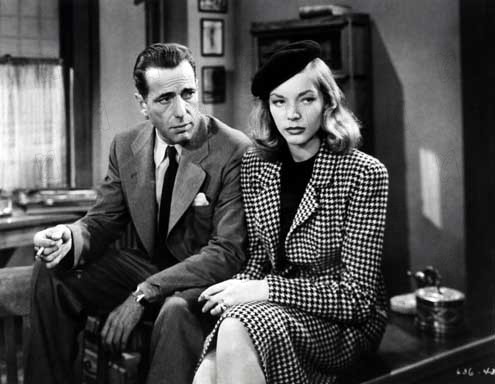
In The Big Sleep, the audience goes on the ride that Bogie and Lauren Bacall take us. All we know is Bogie has been hired by a rich man to figure out why he is being blackmailed by someone because of his daughter doing something wild. From there we meet the two daughters of old Mr. Sternwood. Lauren Bacall is Vivian, Mr. Sternwood’s oldest daughter who has already lost her husband. He ran out some time ago. The movie really doesn’t explore why, but the book does.

The part of Carmen Sternwood fell to Martha Vickers. She was so good in her role that Warner Brothers had to re-shoot some of the movie in order to beef up star Lauren Bacall’s part. The re-shot version is the one that was distributed to everyone in 1946. The original version has only recently been released. Bacall plays a larger role in the 1946 release version and because of this; it has become a film classic. The other version was good, but Warner Brothers made the right call when they released the re-shot version.

So basically Bogie as Marlowe is on a case to figure out why there is blackmail going on. The blackmailer gets shot, so the Sternwood family tells Marlowe to leave the case. He can’t he says, because he has fallen for Vivian. This is about as far as I will take the plot summery because I would hate to ruin the ending. I would also hate trying to figure out all the twists in the plot. Just watch the movie and enjoy the quality acting and chemistry of Bogie and Bacall.

This movie was also directed by Howard Hawks. His touches are present in the movie, as he was an extremely talented slapstick director. He does well with the one-liners that were provided by Raymond Chandler in the book, but he also adds some more of his own.

Arthur C. Clarke said about 2001: A Space Odyssey: to watch the movie and then read the book. Then watch the movie again and read the book again to make sure that you understand everything. That advice would work with The Big Sleep. The movie is great and contains most of the plot of the book, but the book is better and explains more. Everything is tied up into a little bow at the end of each, but, to me, the book does a better job of this. This is also the best movie made from a Raymond Chandler book. Just another reason to watch.