Monday, December 15, 2008

Will you love me in December?


Like any aspiring star in the studio system, Marilyn Monroe had to make her fair share of B-movies with a small role for her and a stock story. One such movie is As Young as You Feel (1951).

The movie is about a man who has reached the age of mandatory retirement at his big company. The company is so big that it is called the Acme Company, this originally is what made the studio system great. Anyway, the man wants to remain on the job as he has nothing to do in retirement and his family can’t stand having him around. So he decides to dress up as the president of the company and do a routine inspection of his branch’s plant in order to change the company policy.

Here is where the story has a bit of social value. It is an indictment of the big businesses in the capitalist system. No one at the branch knows what the president of the company looks like, so they believe the imposter. The head of the branch has a secretary who is played by Marilyn Monroe. She tries to calm her boss, but he is frantic and flustered when he meets the “president” of the company.

Things go well for our formerly retired hero as he tours the plant and makes sure the policy is rewritten. Things begin to go wrong though when he is asked to speak at a local business meeting and accepts. Newspapermen are there and snap the imposter’s picture. They run an article praising the “president” of the Acme Company for his great speech. Well, the real president of the company sees this and wants to know what is going on.

In the end, the man is exposed as an imposter, but gets to remain on the job even after the age of retirement because he likes it and has done a good job. Everything ends happily.

At least on the screen that is. In Marilyn Monroe’s personal life, some troubles occurred during the making of the movie. Her long time friend and agent Johnny Hyde took ill and died. Hyde was an agent at William and Morris and he got her the part in All About Eve (1950) and a nice seven-year contract with 20th Century-Fox. He even offered to marry her and leave all his money to her, but she didn’t accept as she didn’t truly love him. She did, however, make all the funeral arrangements.

One bright spot in Monroe’s personal life came while she was shooting a scene one day. Elia Kazan and Arthur Miller walked onto the set. Kazan wanted Miller to see Monroe. Why Elia Kazan would care a thing about an unknown bit-player is anybody's guess, but Miller was quite impressed by Marilyn Monroe. She felt the same about him. This first impression each got of the other lasted a long time and when both were available, they married.

Friday, December 12, 2008

"Why do they always look like unhappy rabbits?"


Few movies have been accepted better by the Motion Picture Arts and Sciences than All About Eve (1950), which received 14 Academy Award nominations. Only Titanic (1997) has received that amount. The movie won six Oscars, including best picture. It is similar to Titanic in that way. It is dissimilar because the audience doesn’t know what will happen in the end, unlike the ship that is destined for an iceberg.

Ironically, for a movie about two competing Broadway actresses, Bette Davis and Anne Baxter competed against each other for the Best Actress Oscar. Neither won. In fact in a year in which Sunset Blvd. also was released, and Gloria Swanson was nominated for her performance, no actress who played an actress in a movie won the award. It went to Judy Holliday for Born Yesterday. It is believed by some that Baxter and Davis split the votes, and had they not then one of them would have won the award.

On the surface it appears that All About Eve is a heartwarming story about a young actress, Eve Harrington, played by Baxter, who comes of age to become the star of Broadway. But in the realm of the theater, and Hollywood, appearances aren’t everything. There is a nasty underbelly to the theatre world and it is captured perfectly here by Joseph L. Mankiewicz who wrote and directed the picture.

Margo Channing, played by Bette Davis, is an aging Broadway star. She knows it, the critics know it, the producers know and her friends know it. The fans might know it, but they are always the last to figure these things out – or so the belief is in Hollywood and Broadway.

One night after giving a stellar performance, Margo retreats to her dressing room where she meets an adoring fan named Eve. Eve tells Margo a sob story about how she is an actress from Milwaukee who saw Margo one night in San Francisco and was so impressed with her performance that she has followed the actress around ever since. The ushers at the theater can vouch for Eve because they have seen her attend every one of Margo’s performances.

Margo is flattered and Eve is brought on as her secretary. Soon Eve becomes Margo’s understudy. Margo gets a kick out of this because she adores the attention. She also gets an opportunity to be young again through Eve. But soon understudy becomes actress and actress will become competitor for Margo. This Margo doesn’t like. But there isn’t much she can do about it.

Eve has met all of Margo’s theater friends. There is the critic Addison De Witt, played brilliantly by George Sanders. Sanders was an odd man who won an Oscar for his role as the theater critic, a role in which he was perfectly cast as his personality and De Witt’s match well.

Hugh Marlowe plays Lloyd Richards, a successful Broadway playwright. Richards’ wife, Karen, played by Celeste Holm, is Eve’s biggest supporter in the beginning. She encourages the actress to continue on. Like Margo, things backfire on Karen as she finds herself competing with the young actress for her husband’s attention.

Margo and her friends are stuck having to watch the monster Eve take over Broadway and become a huge star. They seem powerless to stop her, all that is except De Witt. He is similar to Eve. He does some checking in Eve’s past and finds out that she really isn’t an actress from Milwaukee, but just some conniving woman who had to leave Milwaukee because of a scandal involving her boss, a married man.

De Witt is as conniving as Eve and does not blow her cover. He sits back and watches Eve get all the rewards that come with being a Broadway star. The movie ends with Eve getting an award and then being confronted by an adoring fan, who happens to be an aspiring actress. The whole cycle begins again.

Marilyn Monroe made an impression of Joseph Mankiewicz with her performance in The Asphalt Jungle. He cast her as De Witt’s girlfriend, another aspiring actress. Her style to getting jobs is different from that of Eve’s. Miss Caswell is unsure of herself. Eve is not. This is the reason why Eve is the star and Miss Caswell is not. Marilyn Monroe at this point was unsure of herself and this might be a reason why it would be three more years before she became a star, although all the star qualities she possessed were present for the short time she was on screen.

Thursday, December 11, 2008

"One way or another, we all work for our vice."


The perfect crime is a topic many stories and movies have dealt with. The perfect crime doesn’t necessarily have to be perfect at all. Things can go wrong with the plan, but as long as the criminals get away with their crime then the crime can be considered perfect. Robbery is a popular subject in fiction because it allows for the perfect crime, but also allows the author to create a moral story if the crime happens to go wrong.

The Asphalt Jungle (1950) is one of those movies that deals with the perfect crime. Like Ocean’s Eleven and Seven Thieves (1960), this movie brings a group of the top criminals in the area together for a job.

Since this is a pretty typical story, with the brains of the operation bringing various personalities together in hopes of scoring a big load, there is not much to describe about the movie. Other than the brains of the operation has just come out of prison, wants one last big job before retirement and uses his connections to find someone who will finance the operation. With finances in place the brains brings together the people he needs for his plan. The robbery is then executed. In The Asphalt Jungle the criminals get the money. It isn’t until they have the movie that things go wrong. The noise from the nitroglycerin blast to open the safe is so loud that alarms from other buildings in the area start ringing, bringing the cops. One of the officers wounds one of the robbers. With the criminal in custody it is only a matter of time before the bunch is found and brought to justice.

John Huston brought this story to the screen. The Asphalt Jungle was originally a novel written by W.R. Burnett. Burnett was one of Huston’s favorite writers. The two first worked together on High Sierra (1941), when Huston was just a screenwriter.

The movie was nominated for four Academy Awards, including best picture. It is still a good watch, but there have been similar movies that have come out in the past 50 years, so the subject matter doesn’t seem so fresh today.

The movie is best remembered today as being Marilyn Monroe’s first big break into Hollywood. She had been an actress for over a year and had appeared in a couple movies before The Asphalt Jungle. But this movie would establish her in Hollywood.

She plays the “niece” of the lawyer who puts up the financing for the crime job. She does not appear on screen for very long, but she does make an impression. When the police come to the lawyer’s house they find him with his mistress Monroe. Marilyn is in fits over what is going to happen to her “uncle.”

This role would lead to similar roles throughout her career as the elegant, dumb blonde. Of course this was the case with most actors who made it as stars in Hollywood. Boris Karloff was always typecast in horror roles, as was Bela Lugosi. Humphrey Bogart in gangster roles and John Wayne in westerns.

It should be noted that John Huston directed Marilyn Monroe in what many consider her first major role, in The Asphalt Jungle, and in her final role, as Roslyln in The Misfits (1961). Both came a long way between the two pictures.

Wednesday, December 10, 2008

"Scotland Yard was baffled; the FBI was baffled. They sent for me and the case was solved immediately: I confessed."


Classic Hollywood is filled with movies that could’ve been. The teaming of Humphrey Bogart and Marlon Brando for Knock on Any Door is one of them. Or Gary Cooper and Alfred Hitchcock on Suspicion. These didn’t work out, but sometimes dream combinations do occur. Charlie Chaplin and Buster Keaton appeared together in Limelight. The two screen legends didn’t quite live up to audience expectations in the scene they both appeared in. This has been the case for several dream combinations though. Like Marilyn Monroe appearing in a Marx Brothers movie.

On the surface this seems like a great combination. One thing the Marx Brothers like is beautiful females. There is no question that Marilyn Monroe fits that definition. So the match seems perfect doesn’t it? Well, the movie they appeared in together, Love Happy (1949), was made over 15 years after the Marx Brothers had their peak in movies and about five years before Marilyn Monroe would become a huge star.

Timing is everything in movies and this one didn’t quite work out. Had the movie been made during the peak of the Marx Brothers’ ability, it would have been great. It also would not have included Marilyn Monroe because at the time she would have been a seven-year-old orphan in Los Angeles who went by the name Norma Jeane Baker.

Love Happy is like a lot of later Marx Brothers movies, it was done because Chico needed money. Actually this movie is all about money, as the production ran out of financing and had to resort to product placement advertising in the movie in order to finish production. The climax of the movie occurs on New York rooftops with Harpo racing around various advertisements.

Speaking of Harpo, if you happen to be a fan of his, then this movie is wonderful. Unlike the other Marx Brothers movies, which tend to focus a majority of the time on Groucho, this movie is basically all Harpo. He came up with the short story in which the movie was based.

As with all the Marx Brothers movies, the plot is always unimportant. The Brothers were on the screen to make people laugh. Harpo has some of his best gags in this movie. Unfortunately, when you are known as one of the Marx Brothers, it hurts the movie when the other family members don’t have any great gags.

The other two Marx Brothers take on Zeppo roles in this movie. They provide the backdrop for Harpo to star. I believe this was alright to Chico, as he was just in it for the money he needed to pay his constant gambling debts. Groucho I’m sure was offended by such a small role, but then again he might not have cared since he was a huge success with his radio quiz show program.

This brings me to Marilyn Monroe. If you look at the DVD cover, you will see Marilyn Monroe and Groucho on the box. It is billed as the teaming of Monroe and the Marx Brothers. Well, if Groucho and Chico can’t get much face time in this movie then you know some unknown blonde will get next to none. And Monroe gets only one quick scene. It might be the best in the movie though -- for those who are not Harpo fans.

Groucho plays a detective who introduces the movie and then stays out of everything for a majority of the picture until the end. He happens to be stuck in a sticky situation, there is a man who has come into his office who says he will kill him in a certain amount of time. It seems like there is no hope for Groucho until a knock at the door comes. Happily, Groucho goes to the door, opens it and sneaks out as someone comes in. That someone is Marilyn Monroe. So, a few seconds later Groucho opens the door and comes back into the office to leer at Monroe.

That was it for Marilyn Monroe in the movie. And that was it for the Marx Brothers together on screen. They would never make a movie together again, although they all appeared separately in The Story of Mankind (1957).

Having wrapped up the Humphrey Bogart movies last week, I will be looking at the movies of Marilyn Monroe from Love Happy till the end of her career.

Friday, December 5, 2008

"Money's not evil in and of itself. The purpose for which it's used is the determining factor."


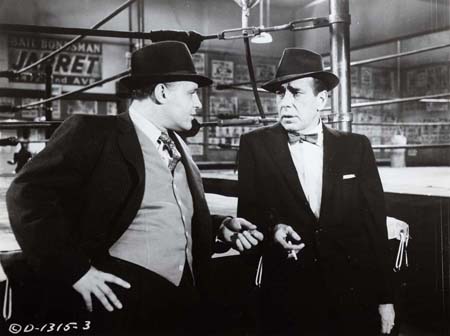
Corruption in boxing is not a new topic in movies. It seems that ever since the invention of the medium, there have been tales about boxing and the corruption in the sport. In fact, boxing is probably the most popular sport movies have dealt with. Of course in recent times, as the sport has lost a lot of popularity, there have been few boxing movies. But in the 1950s, the sport was still going very strong. The last appearance made by Humphrey Bogart on screen came in the boxing movie The Harder They Fall (1956).

The movie was based on the best-selling novel written by Budd Schulberg. It tells of the corruption of the boxing business, certainly not a new topic. As with most corruption in boxing stories, this one deals with greedy managers exploiting uneducated fighters and paying off boxers who will take a fall.

The Harder They Fall follows around washed-up newsman and boxing reporter, Eddie Willis, played by Bogie. He still has a lot of connection in the boxing world and when manager Nick Benko asks if he wants to be a part of his PR staff, Willis says he possibly will if the fighter is any good. Well the fighter is not. The fighter, Toro Moreno, is an import into this country. He looks great when he walks by people, as he is so much bigger than everyone, but he has no boxing skills at all. Willis hates the fighter and doubts his ability, but needs the money so he agrees to help Benko by being a public relations man.

Willis draws up interest in the tomato can’s fights and Benko makes sure the fighters Toro faces are paid to take a fall. Of course, this being the era with no television broadcasting, much less pay-per-view, the only medium covering fights is the newspaper. So Toro becomes a sensation of the newspaper world and the boxing world, despite not being seen by many people.

As Toro works his way up the boxing hierarchy he begins to believe that he has some boxing skills. Of course he has improved, but so have the fighters he is facing. They can easily knock him out, but they are paid better to take falls.

Eventually, Toro befriends Willis, who begins to feel sorry for the foreigner. He is a man in a strange land who has some talent, but has been taken advantage of. Willis agrees to help protect Toro. Of course Benko figures out that Toro is having other ideas – like leaving the boxing world and America. Benko can’t let his cash cow leave, so he takes action to keep Toro in the United States, despite his being exposed as a fraud of a boxer. Toro depends on the friendship of Willis and even though he does betray him the first time, Willis does get Toro safely out of the country.

With Willis going against the will of the Benko mob, it is only a matter of time before he is eliminated. In the waning moments of his career, life and the movie, Willis sits down at his type writer and begins to pound out the whole story under the title, “The Harder They Fall.”

This was not the best send off for one of Hollywood’s greatest stars. Bogie is the narrator of the story, but the Benko character, played by Rod Steiger is a better part. Steiger was a Method actor, while Bogie was a naturalistic one. By the time the late50s rolled around, the Method actor was replacing the naturalistic one in all the best parts, this movie is an example of that. With Bogie’s death a year later, the naturalistic style of acting would be dealt a severe blow.

The legacy of Humphrey Bogart is one filled with characters who were idealist, but not completely ignorant of the imperfect world they lived in. Even Bogie’s gangster characters of the 1930s had traces of this in them. His most famous characters, Rick Blaine, Charlie Allnut, Sam Spade, are filled with this quality.

Bogie is not mentioned today as much as contemporaries like Marlon Brando or John Wayne, yet when AFI created a list of the 50 greatest stars, Bogie was at the top of the leading man category. He might not be as well known today as he should be, but those who have seen Casablanca or The Big Sleep know that he will never be forgotten.

Thursday, December 4, 2008

"You don't have it in ya, Pop."


The Desperate Hours (1955) is a movie that was based on actual events. This story originally appeared in the newspaper as it was developing, then was gobbled up by Joseph Hayes who wrote a novel about the story. He then wrote a play about it. Finally, the story was turned into a screenplay by Hayes and shot by Paramount.

While he was in charge of Santana Productions, Humphrey Bogart saw the novel for The Desperate Hours and wanted to buy it. His small production company, although successful, still couldn’t compete with the major studios in a bidding war. He lost to Paramount. But Paramount knew he would be a good fit in the role of Glenn Griffin, the main gangster bad guy.

The story begins on a typical morning in suburban America in the 1950s. The Hilliard family is getting ready to attack the day. There is Eleanor, the housewife who sees everyone off, Dan, her husband who has to go to work, and finally Cindy and Ralphie, the two children of the family who have to go off to school. Once this all-American family disperses, things start to happen.

In a story that has been used over and over again by writers of all mediums, a group of gangsters invades the home when everyone but the housewife is away. They have broken out of prison and are waiting for something, typically it is money or a girl as in The Petrified Forest (1936). Bogie plays the groups leader, Glenn Griffin, who is a similar character to Bogie’s Duke Mantee in The Petrified Forest. The only difference is Glenn is more grizzled, a man with no ideals so to speak like Duke possessed. Also new is Griffin has a brother, Hal, so the hardened gangster has some sort of heart as he cares for his younger brother.

When the family returns from their hard day at school or work, they are shocked to find the gangsters in their home. A battle of wills ensues between Glenn and Dan to see who will breakdown first. Will Glenn make good on his promises to leave when he gets what he wants or will Dan manage to get these gangsters out of his house so his family can live a normal life. I think we know how this will end.

On Broadway, Paul Newman and Karl Malden where the stars who matched wits. Newman as Glenn and Malden as Dan. In the movie version, Bogie was supposed to match wits with Spencer Tracy. The two were good friends who hadn’t appeared in a movie together in over 25 years. They wanted to appear together one more time before they died. For some reason, it is suspected because of an issue with top billing, Tracy backed out of the production and Fredric March stepped in.

The story is classic and the movie is as well. For a major Hollywood star, who had developed into a romantic lead at one point in his career, Bogie still enjoyed being the bad guy. Glenn Griffin is a fitting tribute to Bogie’s other gangster characters who he played when he was first starting out.

This was the penultimate movie in Bogie’s career. The movie was not as successful as Paramount originally hoped it would be, but it was the last great movie of Bogie’s character. His final movie, The Harder They Fall (1956) will be looked at tomorrow.

Tuesday, December 2, 2008

"If crime showed on a man's face, there wouldn't be any mirrors."


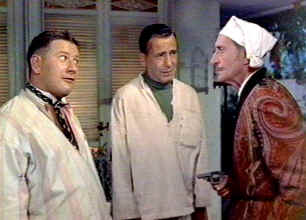
With the success of Sabrina (1954), Humphrey Bogart proved that he was adept at comedy. This fact was not lost on the people at Paramount, who cast him again in a comedic role, this time in We’re No Angels (1955).

This movie is not really all that funny or all that great, but it is one of those movies about the spirit of Christmas. It is about three Devil’s Island convicts who are on work release. They decide that there is a chance to make a break for it and take it. They would have been successful in escaping, had they not slipped up at a local shop. Here they witness a shopkeeper, who they were going to rob, have some of his own problems. Bogie and his two other convicts take pity on the shopkeeper and his family once they see them.

The three who had volunteered to help patch up the shopkeeper’s roof decide to make a long stay and forget their chances of escape. They get to really like the family. The mother, played by Joan Bennett is attractive enough to catch Bogie’s eye, while the family’s daughter, Isabelle, is attractive enough to catch the eye of the two other convicts, played by Peter Ustinov and Aldo Ray.

They help prepare dinner for the family, Bogie manages to “borrow” a turkey from a local farm after making his best attempts to buy the bird with no money. They make themselves great servants for the family that has fallen on hard times. The father’s cousin wants to take over the shop and when he arrives to claim the shop that the father has run into the ground because of his generosity, the three convicts rush to cook the books.

They fail in this attempt and seems like the nice people will lose their shop. Of course, this being a funny, sentimental story, the three convicts use their associate named Adolph to help them save the day. Adolph happens to be an adder who escapes from the box he is kept in and miraculously gives anyone who happens to be mean to the family a nice bite.

I probably made the movie more complex than it really is in my description above. Really it is just a lavish Christmas picture that is filled with some laughs, but a lot of sentimentality. The movie was shot in color with a big budget and directed by Michael Curtiz, one of Bogie’s favorite directors.

Bogie is good as the straight man of the group. Basil Rathbone is good as the cousin to Leo G. Carroll’s shop owner/father of the family. The mother, Joan Bennett has an interesting story though. She had been blackballed in Hollywood for many years. Her husband was Walter Wanger, a neighbor to Bogie and big shot producer in Hollywood. In 1951, the Wanger family was involved in a bit of a scandal when Wanger took exception to his wife having an affair with her agent. Wanger took matters into his own hands and shot the agent in the groin. The agent recovered and Wanger spent a few months in jail. Bennett was the one who got the worst of this deal. She was unable to find work, despite having over sixty-five film credits to her name including playing the mother in Father of the Bride (1950). When We’re No Angels was shot, it was only her second screen appearance in the past three years. The producers at Paramount did not want to use her, but buckled when Bogie stood by her and said he wouldn’t do the picture unless she was cast as the mother. Bogie and Paramount were rewarded when she gave a great performance.

We’re No Angels is a nice, family, holiday movie. It is good clean fun and something enjoyable for all.